For this one, I needed to do a bit of a social network map. I did this by hand, and will continue referring to it below.
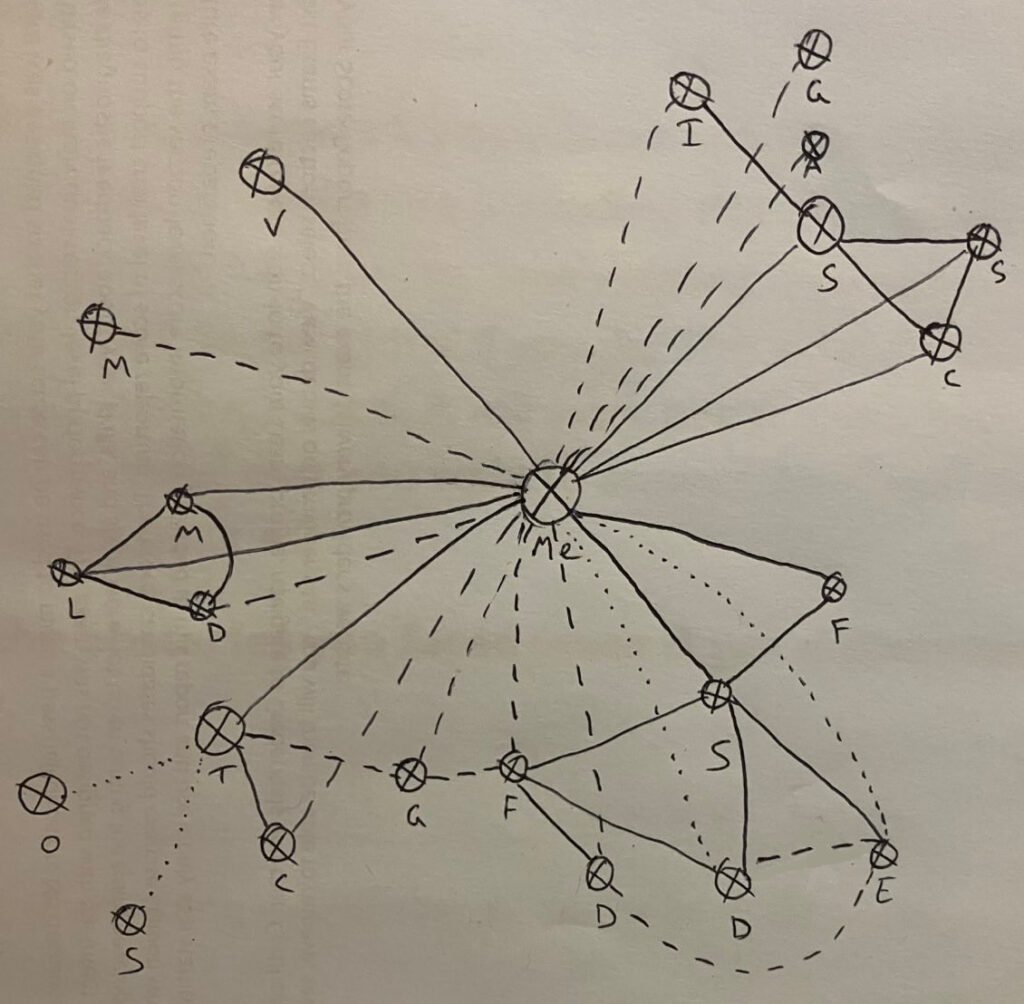
This is an egocentric map, as that’s a projection that makes the most sense to me for this example. “Strength” of the relationship (as assessed by me) is measured by the type of line, moving from a solid line for the strongest connections, through a dashed line, to a dotted line for the weakest connections. Connections between nodes other than the central node are assessed by observation and supposition; I haven’t taken a poll of anybody on this! Link reciprocity is not directly assessed or indicated here.
In a general sense of speaking, most of the people in my house are located in the lower-left corner, with immediate biological family in the mid-left. Friends and family in the Seattle area are located in the lower-right corner, with some crossover in the lower middle created by long mutual involvement in a non-profit. (There is one exception–the placement of the node labelled “F” on the lower-to-middle right was an oversight, and it should be more correctly clustered with other nodes on the lower-left!)
The upper-right section is a very partial graph of connections into my workplace, and the upper-left holds two connections to good friends online who are not otherwise connected to other nodes on the graph.
One of the first things to stand out to me is the fact that most of the connections I have drawn to myself are considered to be highly or moderately strong. On reflection, this does make sense–these are the connections most likely to stand out and therefore most likely to be drawn (except where the receiving nodes are already drawn into the graph, in which case adding a link is of trivial effort).
Another point that is relatively clear to be seen is that there is a fair amount of crossover between two otherwise-distinct clusters–a house in Vancouver and a house in Seattle. While those clusters were drawn using physical location as an organizing principle, the friendships created over a mutual interest and activity have created many links between these two locations in social space.
Conversely, my biological family, workplace, and notable Internet-only connections have no connections between each other or to the other groups. This reflects definite intention on my part, as some of these areas of life are deliberately kept partitioned from each other. (In the case of the Internet-only connections, this is actually less intention and more simply a case of circumstance, but the effect, as with the others, is to have them partitioned away from everything else in the network nearly completely.)
In every direction, the graph could certainly be extended, with direct relationships growing weaker and more remote as I went. (My workplace alone would probably double the size of the overall graph.) I expect that, even as these groups continued to grow and display more interconnections with each other, the partitioned groups would stay partitioned, and the connected groups would grow ever more so.
Leave a Reply